Dry trees and tall grasses cover the banks of a glassy lake in the Okanogan Valley.

Explore Washington Natural Beauty.

Endless discoveries for people who love natural beauty.

elk What defines Washington State’s natural beauty? Big mountains, big trees, big water and big vistas—you’ll find them all here. In the interest of full disclosure, we should tell you that many Washingtonians believe that this is the most beautiful place on earth. And while we acknowledge a certain amount of native bias in that opinion, any nature lover would have to admit that Washington is one of the world’s most scenic places. Unquestionably, the state contains an astounding diversity of natural beauty. From its Pacific coast beaches to the 14,410-foot snowcapped summit of Mount Rainier, from the soggy, mossy depths of the Hoh Rainforest to the arid, sage-covered expanse of the Horse Heaven Hills, Washington offers endless discoveries for people who love natural beauty. Seek and you shall find.

But where do you even begin?

The water’s edge is as good a place as any. Washington’s Pacific coast offers a wealth of beaches; some you can drive on (Long Beach) and some are so wild you can’t get a car within 20 miles of them (stretches of protected shoreline in Olympic National Park). Even most Washingtonians don’t know that the state’s 170 miles of Pacific coast is only a small fraction of its total saltwater coastline. But when you take into account Washington’s numerous bays and tidal inlets, the perimeters of its coastal islands, the San Juan Islands, and the islands of Puget Sound, and then add in the shorelines of the Strait of Juan de Fuca, Admiralty Inlet, Hood Canal and Puget Sound, Washington has an astounding 3,036 miles of saltwater coastline. [Source: U.S. Department of Commerce, National Oceanic and Atmospheric Administration (NOAA).] To put it another way, if you stretched out the states’ meandering coastline into one straight line, it would more than cover the distance from Seattle, Washington to Washington, D.C.

elk Washington is also home to many beautiful rivers, none more majestic than the mighty Columbia, the largest river in the Pacific Northwest and the largest hydroelectric power-producing river in North America. The Columbia flows from the western slopes of the Canadian Rockies in British Columbia, crosses into the U.S. at the far northeast corner of Washington state, winds all the way to the far southwest corner of the state, and drains into the Pacific Ocean at the boundary between Washington and Oregon. Along the way, it flows through the Grand Coulee Dam, which is the largest single producer of hydroelectricity in the United States. The Columbia River Gorge is famous for its vast panoramas of spectacularly dramatic scenery. Its strong winds also make it a world-famous windsurfing destination.

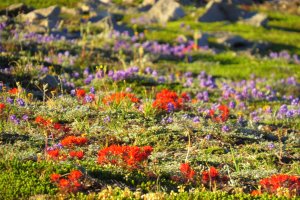
Then there are the mountains. If you love mountains, Washington is a dream come true. The state has numerous mountain ranges, but the two largest are the Olympic Mountains and the Cascade Range. The Olympic Mountains take up most of the Olympic Peninsula (which is the far northwest corner of Washington State and of the contiguous United States). Largely protected within the confines of Olympic National Park, the Olympics offer the most spectacular examples of the state’s coastal temperate rainforests (especially in places like the Hoh River Valley), beautiful alpine meadows (a riot of wildflowers in spring), muscle-soothing hot springs, and some 70 miles of protected Pacific coastline. At the park’s northern boundary—in the shadow of the aptly named Mount Storm King—you’ll find one of Washington’s largest and most beautiful freshwater lakes, Lake Crescent. Here, you can watch layers upon layers of mist rise and form into rain clouds above the steep-walled, rainforest-covered mountains that surround the lake for miles around—a truly spectacular sight, especially at sunrise and sunset.

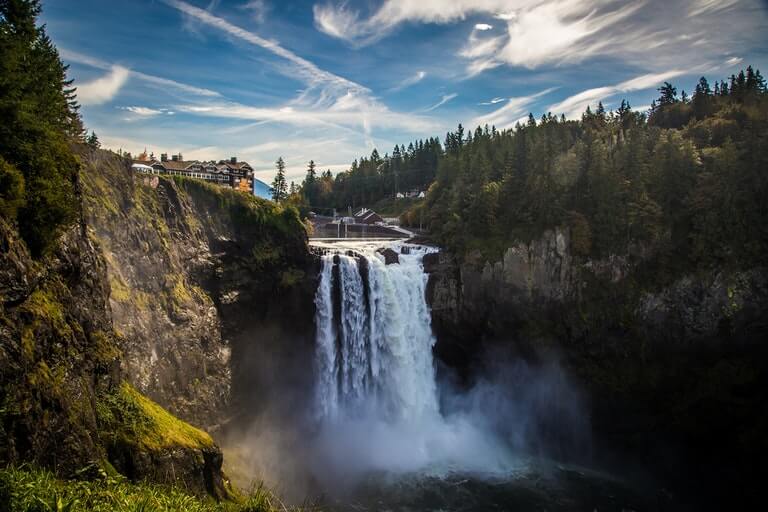
The Cascade Range is just as beautiful, bisecting the state north to south, from Mount Baker and the North Cascades National Park at the Canadian border all the way to the Columbia River Gorge at the farthest southern reaches of the state. In addition to Mount Baker, the Cascade Range incorporates Mount Rainier National Park, Mount Adams and Mount Saint Helens National Volcanic Monument. The Cascade Range also creates a barrier to coastal weather systems, making western Washington a lush, green land of temperate rainforests and giving eastern Washington a drier, much sunnier climate. The western slopes of the Cascade Range are dominated by its temperate rainforests (including some spectacular old-growth in North Cascades National Park and Mount Rainier National Park), while the eastern slopes are the domain of the state’s magnificent ponderosa pine forests. Both sides of the range are graced by a wealth of glacier-fed rivers and waterfalls that give meaning to the name “Cascade.”

Many of Washington’s waters, mountains and forests are protected by the state’s three national parks, some 120 state parks, numerous wilderness areas, recreation areas and preserves. It’s no surprise then that Washington is a haven for watchable wildlife: whales and other sea mammals, migratory and native birds, deer, bears, cougars, otters, foxes and much more. It is also a haven for outdoor enthusiasts who flock to the state to hike, camp, bike and enjoy all sorts of outdoor activities, winter sports and water sports.

If you’re looking for America the Beautiful, you’ll find it in Washington. Spacious skies? Check. Amber waves of grain? You bet. Purple mountain majesties above the fruited plain? Wenatchee! Shining sea? Yes—from the mouth of the Columbia to the Strait of Juan de Fuca.