Top 10 Things to Do in Seattle When It Rains

Ah, famously soggy Seattle. That marvelously mossy metropolis. Rain City. Aquacadia. Precipitation Nation. America's Water Belt.

Just how wet is Seattle? You can take sightseeing tours in amphibious vehicles. (Yes, really.) If you "save it for a rainy day" you won't have to wait long to spend it here. If you walk around crying no one will notice. Seattleites are so used to the weather that surprisingly few of us use an umbrella even if we own one. We have 157 words for rain. We say "pre-warped" instead of "straight." We worship the windshield wiper. And cheer ourselves with buck-up-little-camperisms like "There is no bad weather, only bad gear" and waterlogged witticisms such as "Wet is the new dry" and "Only four more months till the sun comes back!" Ha. Wet enough for you?

In reality, Seattle weather is sunny (or "nice" as non-Seattleites call it) about six months out of the year. But we don't talk about that, because more people would move here if they knew and we'd have to modernize the freeway system. Dry fact: Seattle isn't even one of the Top 10 Rainiest Cities in the U.S. (all of which are in Gulf Coast states). It might be the mistiest, however. Whatever our rainy season lacks in depth, it makes up for in length.

So it's no surprise that Seattle offers some great wet-weather diversions, many of which feature that highly desirable combination of fresh air and shelter from the rain. Here are some local favorites:

1. Explore Pike Place Market

Infused with more than a century of history and character, Seattle's famous Pike Place Market might just be the heart and soul of the city. Unquestionably, it's a great hub of Seattle life. It's also a showcase for Washington State food, wine, arts, culture, and heritage. A feast for the senses, the market offers a dazzling array of arts, crafts, and curios; a soundscape of street musicians, hawking produce vendors, and extroverted fishmongers; and a melting pot of international cuisine and ingredients. Its covered open-air walkways laden with fresh produce and cut flowers are always a cheerful riot of color and a big reason why it's a rainy day favorite. The main entrance to the market is at Pike Street and First Avenue, within easy walking distance of the waterfront, Seattle Aquarium, Seattle Art Museum, the downtown shopping district, and much more. (Watch out for flying fish.)

2. Marvel at the Seattle Art Museum

A stone's throw south from Pike Place Market on First Avenue you'll find the Seattle Art Museum (look for the giant "Hammering Man" sculpture out front). Also known as SAM, this world-renowned institution has three Seattle locations: downtown, Seattle Asian Art Museum in Volunteer Park, and the Olympic Sculpture Park in Seattle's Belltown district. In addition to housing traveling exhibitions from around the world, SAM has an extensive permanent collection of some 25,000 objects from 140 cultures, including an extraordinary Native American exhibit. Large enough to lose yourself in for an entire rainy day, the new (as of 2007) downtown museum is inspiring without being overwhelming. Centrally located, SAM is within easy walking distance of Pike Place Market, the waterfront, and the downtown shopping district.

3. Check out Seattle Aquarium

Seattleites share a special kinship with aquatic life forms. Appropriately then, Seattle Aquarium—at Pier 59, just down the hill from Pike Place Market and the Seattle Art Museum—is an exceptionally cool aquarium that's definitely more than just a giant fish tank. Its diverse exhibits and marine habitats house fish, octopi, crustaceans, anemones, glow-in-the-dark jellyfish, shorebirds, seals, and sea otters (creatures so cheerful they make dolphins seem depressed). Be sure to check out the Underwater Dome, a spherical undersea room with a 360-degree view of a 400,000-gallon tank that's home to salmon, rockfish, lingcod, giant sturgeons, and the ever-popular sharks. Feeding (frenzy) time in the Underwater Dome is 1:30 p.m. daily, and it's one of the best shows in town. Seattle Aquarium also features several open-air exhibits, but the covered walkways keep visitors dry on rainy days.

4. Get away on Washington State Ferries

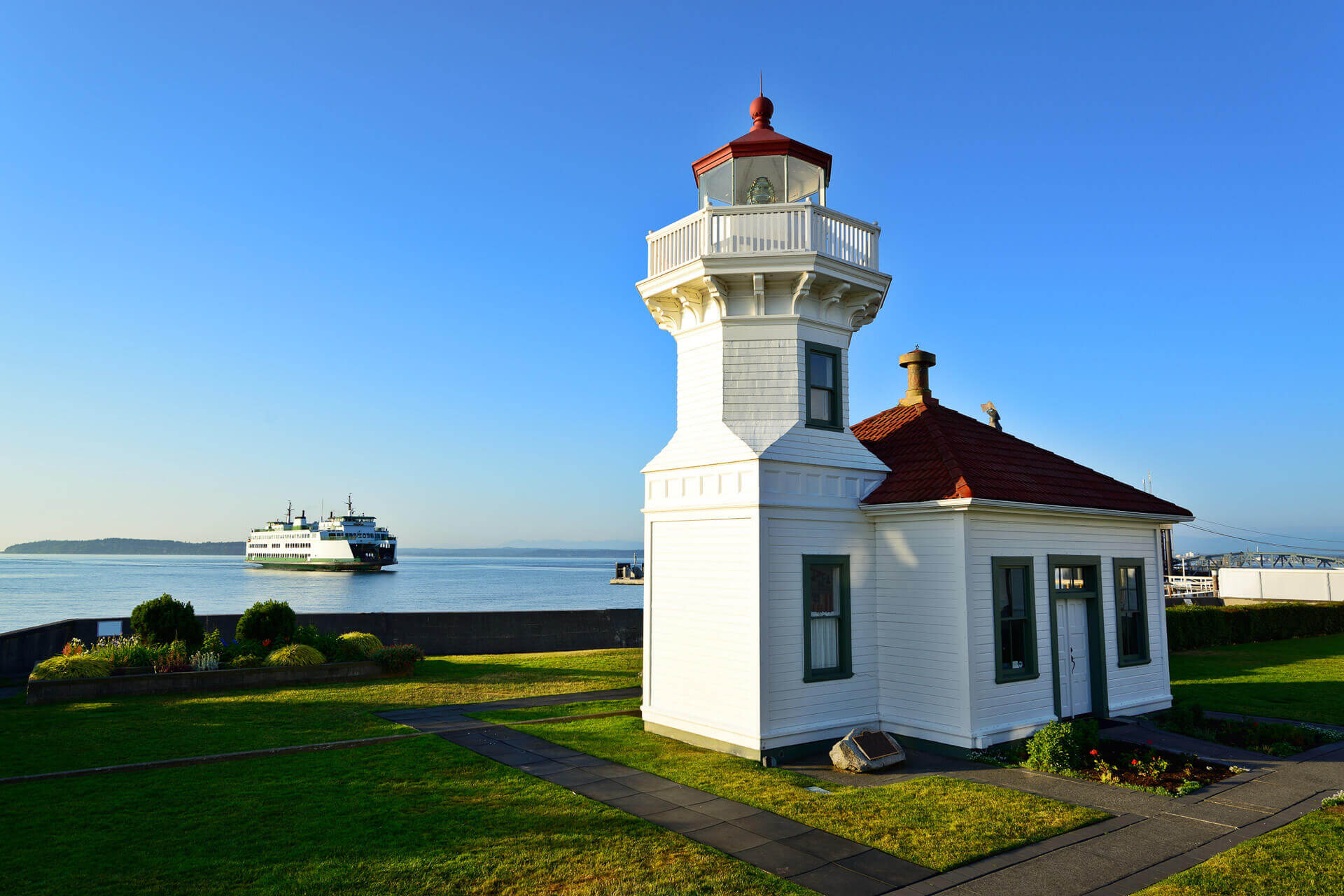
Seven piers south of Seattle Aquarium on Alaskan Way is the main Seattle terminal for Washington State Ferries at Pier 52. Ferry sailings are frequent and walk-ons are welcome. If you buy a walk-on ticket to Bremerton, Bainbridge Island, or Vashon Island (the Vashon ferry departs from nearby Pier 50), you can stay on the ferry and catch a ride back, no charge. Walk-on fares vary by crossing but are always a great bargain for adults and cheaper still for kids and seniors. Roundtrip rides offer ample time for sightseeing without eating up your whole day. Crossing time to Bainbridge and Vashon is about 35 minutes each way. Crossing time to Bremerton is about 60 minutes each way—a longer trip that takes you to the Kitsap Peninsula by way of scenic Hood Canal. All Puget Sound crossings offer extraordinary views of Washington State's natural beauty. Though sometimes obscured by clouds, scenic highlights include the Olympic Mountains to the west, the Cascade Range to the east, the ever glorious Mount Rainier, and numerous forests, beaches, and islands. And there's no better view of the Seattle skyline. For rainy day travelers, Washington State Ferries offer covered open-air decks. Or you can buy a bowl of hot clam chowder in the cafeteria, sit on the cushy seats, and enjoy the view out the giant windows.

5. Ride the Ducks

Why a duck? Because, when it comes to sightseeing in Seattle, there is nothing like a duck. 'Ride the Ducks of Seattle' tours boasts the city's only fleet of DUKWs—authentic World War II amphibious vehicles (or "duck mobiles," as Seattleites often call them). Ducks let tour participants see Seattle by land and by sea without getting out of their seats. Duck pilots/drivers are Coast Guard-certified maritime captains and famously knowledgeable and funny tour guides. Duck season is February 27 through the end of November. The Ducks have roofs above and open-air "windows" on the side, making them yet another Seattle activity that offers fresh air and (relatively) dry conditions on rainy days. Ride the Ducks tours take in many interesting local sights, including downtown Seattle's historic Pioneer Square district.

6. Tour Underground Seattle

It's no myth. Beneath Seattle's historic Pioneer Square lies an underground city—or what remains of one, anyway. How did it get there? Well, once upon a time, much of downtown Seattle was built on a massive mud flat. Now, please don't ask why anyone would build a city on mud flat in a rainy part of the world. Suffice it to say that this was not the best idea ever, and things got messy fast. By the late 1800s Pioneer Square's infamous mud puddles were large enough to swallow up small children and dogs (though it's debatable whether they actually did). When the Great Seattle Fire of 1889 leveled approximately 25 square blocks of wood buildings in and around Pioneer Square, the city fathers saw an urban renewal opportunity and declared that, forthwith, all downtown buildings must be constructed from brick or stone. Furthermore, in order to rise above muck and mud puddle, city streets would have to be elevated at least eight feet—a task accomplished in part by grading the steep bluffs directly to the west and dumping the fill-dirt into Pioneer Square. To make a long, muddy, environmentally insensitive, and frankly ridiculous story short, there's still a subterranean world of old streets, walkways, and buildings beneath the surface of Pioneer Square. Bill Speidel's Underground Tour can take you there. Good news: It never rains in Underground Seattle. And the mud puddles are gone now.

7. Lose yourself in The Elliott Bay Book Company

Speaking of Pioneer Square, The Elliott Bay Book Company ("Seattle's legendary independent bookstore") is one of that neighborhood's true gems. Located in the historic Globe Building at the corner of First Avenue South and South Main Street, the store offers more than 150,000 new, used, and rare titles arrayed throughout a multilevel labyrinth of bookshelves, rooms, nooks, crannies. Creaky wood floors, high ceilings, and exposed brick walls only add to this charming Seattle landmark's reputation as a reader's paradise. Upstairs, you'll find an amazing selection of books and publications; downstairs, the Elliott Bay Café serves up a delicious, diverse, and reasonably priced menu of soups, sandwiches, salads, baked goods, coffee, tea, beer, and wine. The Elliott Bay Book Company is a wonderful place to pass the hours on a rainy day. You can leisurely browse for books and then enjoy your prized purchases over a snack, meal, or beverage.

8. Experience EMP

It's hard to miss Experience Music Project (EMP). But if you're having trouble finding it, it's right next door to Seattle's most famous landmark, the Space Needle. Part building, part sculpture, the 140,000-square-foot Frank O. Gehry-designed architectural marvel (do not say "blob," please) houses one of the world's great music museums. A must-see, must-hear experience for any serious music lover, EMP features rare music artifacts and memorabilia and interactive exhibitions that encourage participation, creativity, and true music appreciation. One of Seattle's most popular attractions, EMP has welcomed many millions of visitors since it opened in 2000. To paraphrase native son Jimi Hendrix, EMP is the perfect place to dream away a rainy day.

9. Breathe deep at Volunteer Park Conservatory

Up the hill from EMP and the Space Needle, at the north end of Seattle's ever dynamic Capitol Hill neighborhood, you'll find Volunteer Park, one of the city's most beautiful and historic parks and site of the Volunteer Park Conservatory. Completed in 1912, the conservatory is a classic Victorian-style greenhouse with a lush and lavish collection plant life that will charm any foliaphile. The building features five "houses," three of them with tropical climates (Bromeliad House, Palm House, and Fern House), one with a temperate climate (Seasonal Display House), and one with an arid climate (Cactus House). No matter what the weather's doing outside, it's always a breath of fresh air and a perfect summer day inside the Volunteer Park Conservatory. Admission is free.

10. Watch the ships and the salmon go by at the Hiram M. Chittenden Locks and Fish Ladder

A still-thriving maritime community, Seattle's historic Ballard neighborhood is home to the Chittenden Locks (more commonly called the "Ballard Locks"—probably because it's not very easy to say "Chittenden"). Located at the confluence of Salmon Bay and the Lake Washington Ship Canal, the locks are the only conduit between the fresh waters of Lake Washington and Lake Union and saltwater Puget Sound (and, by extension, the Strait of Juan de Fuca and the Pacific Ocean). Maritime traffic through the Chittenden Locks includes commercial ships, pleasure boats, and working fishing vessels traveling to and from Fishermen's Terminal on Salmon Bay. When visiting the Chittenden Locks, be sure to check out the Fish Ladder viewing room, where, sheltered from the rain, you can watch Chinook, sockeye, coho, and steelhead salmon migrating up the ladder and around the locks as they return to their runs in the Cedar River Watershed. It doesn't get much more authentic Northwest than this.